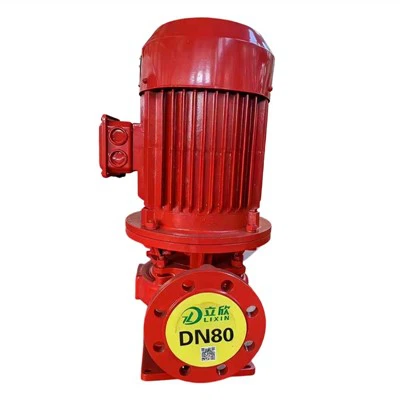
Hey there! As a supplier of high-rise building booster pumps, I often get asked about how to calculate the required power of a high-rise building booster pump. It's a crucial question because getting the power right ensures that the pump can effectively meet the water supply needs of a high-rise building. So, let's dive into it!
Understanding the Basics
First off, we need to understand what a high-rise building booster pump does. In a high-rise building, the water pressure from the main supply might not be enough to reach the upper floors. That's where the booster pump comes in. It increases the pressure of the water, making sure that every floor gets an adequate supply.
The power of a pump is measured in kilowatts (kW). The required power depends on several factors, including the flow rate, the total head, and the efficiency of the pump.
Flow Rate
The flow rate is the volume of water that the pump needs to deliver per unit of time. It's usually measured in cubic meters per hour (m³/h) or liters per second (L/s). To calculate the flow rate, you need to consider the number of occupants in the building, the type of fixtures (like toilets, showers, and faucets), and the peak water demand.
For example, in a residential high-rise building, you can estimate the peak water demand per person. Let's say it's around 0.2 m³ per day per person. If the building has 500 residents, the total daily water demand would be 500 x 0.2 = 100 m³. But we're interested in the peak flow rate, which might occur during morning or evening hours. A common rule of thumb is to assume that the peak flow rate is about 2 - 3 times the average flow rate during these peak periods.
Let's assume a peak factor of 2. So, the peak flow rate would be (100 m³ / 24 h) x 2 ≈ 8.33 m³/h.
Total Head
The total head is the amount of pressure the pump needs to overcome to deliver the water to the desired height and through the piping system. It includes the static head, the friction head, and the pressure head.
- Static Head: This is the vertical distance between the water source (like the water tank) and the highest point of water delivery in the building. For example, if the water tank is on the ground floor and the highest floor is 50 meters above the ground, the static head is 50 meters.
- Friction Head: As the water flows through the pipes, it encounters friction. The friction head depends on the length, diameter, and roughness of the pipes, as well as the flow rate. You can use empirical formulas or pipe friction charts to calculate the friction head. For simplicity, let's say that for a given piping system, the friction head is estimated to be 10 meters for our example building.
- Pressure Head: Some fixtures in the building might require a certain minimum pressure to operate properly. For example, a showerhead might need a pressure of 20 meters of water column. So, we need to add this pressure head to the total head calculation. Let's assume a pressure head of 20 meters.
The total head (H) is then the sum of the static head, friction head, and pressure head. In our example, H = 50 + 10 + 20 = 80 meters.
Pump Efficiency
Pump efficiency is the ratio of the useful power output of the pump to the power input. It takes into account losses due to friction, leakage, and other factors within the pump. Different types of pumps have different efficiency ratings. For a well-designed high-rise building booster pump, the efficiency can range from 60% to 85%. Let's assume an efficiency (η) of 75% or 0.75 for our calculation.


Calculating the Required Power
The formula to calculate the required power (P) of a pump is:
[ P=\frac{ρgQH}{1000η} ]
where:
- (ρ) is the density of water (for fresh water, (ρ = 1000 kg/m³))
- (g) is the acceleration due to gravity ((g = 9.81 m/s²))
- (Q) is the flow rate in m³/s
- (H) is the total head in meters
- (η) is the pump efficiency
First, we need to convert the flow rate from m³/h to m³/s. Our flow rate (Q = 8.33 m³/h=\frac{8.33}{3600}≈0.00231 m³/s)
Now, we can plug in the values into the formula:
[ P=\frac{1000\times9.81\times0.00231\times80}{1000\times0.75} ]
[ P=\frac{181.752}{750}≈0.242 kW ]
Choosing the Right Pump
Once you've calculated the required power, it's time to choose the right pump for your high-rise building. At our company, we offer a wide range of pumps to meet different needs.
For example, if you're looking for a reliable pump for general water supply, you might consider our Single-Stage Double Suction Split Case Pump. It's designed to handle large flow rates and high pressures, making it suitable for high-rise buildings.
If you need a pump for HVAC condensate drainage, our HVAC Condensate Drain Pump is a great choice. It's built to efficiently remove condensate water from HVAC systems.
And for applications where you need to boost the pressure of hot water, our Hot Water Booster Pump is designed to handle the high temperatures and pressures associated with hot water systems.
Conclusion
Calculating the required power of a high-rise building booster pump is a multi-step process that involves understanding the flow rate, total head, and pump efficiency. By accurately calculating the required power and choosing the right pump, you can ensure a reliable and efficient water supply for your high-rise building.
If you're in the process of selecting a high-rise building booster pump or have any questions about the power calculation, don't hesitate to reach out. We're here to help you make the best decision for your project.
References
- Fluid Mechanics textbooks
- Pump manufacturer's catalogs and technical manuals